


Thirty millimetres that give, then come back.

Slow-rebound foam sinks under a palm and returns over a second or two.
One-piece foam play mat
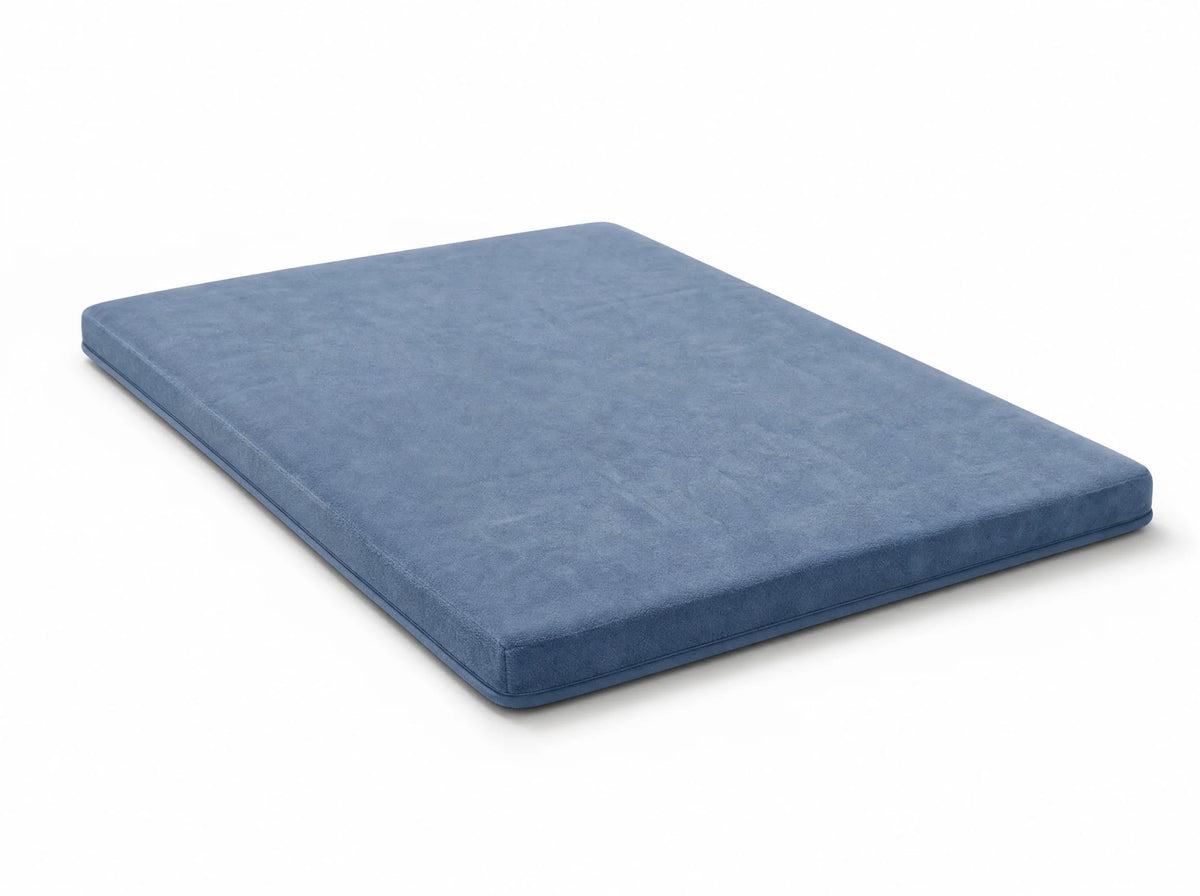
A single slab of 30 mm slow-rebound foam under a coral-velvet surface you wipe with a cloth — one continuous piece, where a tile mat puts thirty-six seams across the same floor.
One piece. No seams to open.
A single slab of 30 mm slow-rebound foam under a coral-velvet surface you wipe with a cloth — one continuous piece, where a tile mat puts thirty-six seams across the same floor.
One continuous surface
Wipe-clean velvet top
30-day returns
Couldn't load pickup availability


How it is built
An interlocking mat is not one surface — it is thirty-six or seventy-two pieces meeting at seams. A seam is a line the surface can open along, and a line a spill can find.
The slab arrives as one continuous piece. There are no puzzle teeth to lift, no tiles to reassemble after a toddler discovers them, and no grid of joins running across the field of play.
The coral-velvet face is unbroken, so milk and crumbs sit on the surface and come off with one pass of a damp cloth instead of finding a channel between two pieces.
The underside is a plain non-slip backing, and the weight of a single slab keeps it flat on hard floors rather than travelling across the room in sections.
Before you buy
Slow-rebound foam sinks under a palm and returns over a second or two.

No puzzle teeth, no tiles, no grid of joins across the surface.

Measure to the furniture line first — the thickness matters less than the reach.

An unbroken velvet face wipes clean in one pass.

A bound edge and a non-slip underside, on hard floors.

The open floor becomes the place everyone sits.
Why choose it
A single slab, not tiles. There is no seam for a spill to find and none for small hands to lift.

Press it and the foam sinks, then comes back over a second or two. A 10 mm tile barely moves — there is less of it to move.

Five cuts, from a corner of the room to the whole open floor. Measure to the furniture line and buy the one that reaches it.

The face is coral velvet and unbroken, so what lands on it comes off it. Machine washable.

A bound edge that does not curl and a plain non-slip underside.
A mat made of tiles is a floor made of seams.
Seams lift. Spills find them.
This one arrives as a single slab.
The floor is just the floor again.
Straight comparison
Each format is good at something. Here is where they actually differ, on what each seller publishes.
| Feature | One-piece foam slab | Interlocking tiles | Thin rolled mat |
|---|---|---|---|
| The surface | One continuous piece | 36 or 72 pieces, seams across the field | One continuous piece |
| Where a spill goes | Stays on top of an unbroken face | Can reach a seam | Stays on top |
| Published thickness | 30 mm | Commonly 10–25 mm | Commonly under 10 mm |
| Moving and storing it | One large piece, no small box | Packs down into a small carton | Rolls up |
| Reconfiguring the shape | Fixed rectangle, five cuts | Tiles fit odd corners | Fixed rectangle |
Swipe the table to see every column →
Compared on published construction and published dimensions. We have not run laboratory tests and do not claim results we do not have.

Plain terms
Said plainly: this mat is big. It arrives as one slab, not a carton of tiles — if you rearrange the room every month or pack the mat away each season, tiles are easier to live with.
Everything else about that size works for you. No seams means no gap for milk to sink into, no edge for little fingers to peel up, no rebuilding the floor after every clean. Lay it down once and the ground under your baby is one soft, wipe-clean surface — every inch of it the same.
From customers

Our Cushvia is amazing. So so soft and plush. Perfect addition to our space. We all love it - pets included 🤍☁️✨
Demi R.

Lovely to walk on, lie on, and easy to clean. My dog and grandchildren love it too. Really enjoying my Cushvia, thank you.
Sue F.

This mat is soooo plush! Our family love just lounging around in it. Might sell my couch as nobody sits on it anymore!
Nancy R.
Specs
One piece
The mat arrives whole and stays whole. It is a single slab from one edge to the other, so you can wipe the whole play area in one pass and a crawling baby meets the same surface everywhere on it.
30 mm
Slow-rebound core, one continuous piece
5 sizes
From a corner of the room to the whole open floor
30 days
To change your mind, refunded on the product price
Before you buy
One piece. The slab arrives as a single rectangle with a bound edge on all four sides. There are no puzzle teeth, no tiles and no seam anywhere across the surface — that is the whole reason this format exists.
The core is 30 mm of slow-rebound foam, in one continuous piece. Press it and the foam visibly compresses under your hand and returns over a second or two, where a 10 mm tile has very little to give. We describe how the foam behaves, and we leave any claim about what it would do in a fall to people who have tested for it.
Measure the open floor before you think about thickness. Measure from the furniture line to the wall and buy the cut that reaches it — a baby does not stay on a 4 × 6 corner of the room. The five cuts run from 39 × 59 in to 118 × 157 in.
We do not publish a third-party test certificate for this mat, and we would rather write that here than print a standard we cannot show you. What we do publish is what it is made of: a 30 mm slow-rebound core in one continuous piece, a coral-velvet face and a bound edge on all four sides.
The velvet face is unbroken, so most of what lands on it lifts with a damp cloth in one pass. The cover is machine washable.
The underside is a plain non-slip backing, and the slab is one heavy piece rather than sections that travel independently across a hard floor.
Send it back within 30 days of delivery for a refund of the product price. It is a large item, so read the size line twice before ordering — that is the mistake that costs the most to undo.
30-day returns · Free US shipping
Roll it out across the open floor, press a palm into it, and wipe something off it. If it does not earn the space, send it back within 30 days for a refund of the product price.
Free US shipping · secure checkout